Sunday, 15 July 2012

Mihail Sebastian: Reading Past Lives and Enduring Problems

One of my companions for the past year has been Mihail Sebastian's Journal. At 620+ pages it is quite a read, but it is not because of its length it takes me so long to finish it: it's because I can only take it in relatively small doses.

Mihail Sebastian (born Iosif Hechter, 1907–1945) was a Jewish-Romanian writer and playwright in pre-WW2 Bucharest, a time of booming intellectual activity but also one of increasingly vocal nationalism, and fascist and anti-Semitic fervour. Sebastian burst onto the literary scene in 1934 with a controversial novel , "De doua mii de ani" (For Two Thousand Years), dealing with the condition of the Jew in the contemporary Romanian society. The controversy stemmed not only from the first person narrative (which may be construed as being to some point autobiographical), but also from the introduction written by Sebastian's mentor, the philosopher and journalist Nae Ionescu. Although Ionescu's text was overtly
anti-Semitic, blaming the Jews for their own suffering, Sebastian decided to publish it. In this way, he attracted the ire of segments from both the Zionist and the nationalist movements.

Notwistanding the increasingly nationalist and anti-Semitic atmosphere, Sebastian was part of a very lively group of young writers and journalists, including Mircea Eliade, Eugene Ionesco and Camil Petrescu, and was very active on Bucharest's intellectual stage.

The Journal shows Sebastian worrying constantly about his work, and struggling to write - and forcing himself to record his thoughts in the journal. In this way, we get to assist
to the birth of his first play, Jocul de-a vacanta (Playing at holiday), and the novel Accidentul (The Accident). We go with Sebastian through various amorous episodes, through trips to the mountainside and skiing, and we find out about his love of classical music.

And then we find out about the political and social troubles. Although the social situation had deteriorated enough by the time the war started in 1939, with casual anti-Semitism cropping up more and more often, even in his close circle of friends, Sebastian's world truly begins to collapse once Nazi Germany begins to conquer Europe. As a Jew, Sebastian was barred from working as a lawyer (a profession he was not very keen on practising), lost his job as a book editor, and could no longer publish because of the racial laws enacted by the pro-fascist regime. And at some point his radio - his main connection to the outside world, a source of both hope and despair - is confiscated, as yet another racial law comes into force.

There are many things which can make one seethe with indignation. But this note from November 1941 summarises very well why I feel I can take the Journal only in small doses, thus keeping depression at bay:

"Ceausescu * - the general secretary at the Economics Ministry - listened avidly to the French-language bulletin from London at 11:15, happy that fifteen thousand Germans and Italians had been taken prisoner in Libya. He too is expecting a British victory. But in the interim he sees nothing odd in holding public office under the present regime. Incompatibility is not a problem that occurs to people here on the Danube."
- - - -
no relation to the future dictator.

PS - my favourite work of Sebastian's is his play Ultima ora (Final Edition), taking place in a news-room. It is a play about typos and misunderstadings, which reveals in an admirable manner the true workings of the press industry and its relationship with people in positions of power. 

Tuesday, 26 June 2012

Killing Generals

This post takes its name from Bogdan Hrib's novel Kill the General, a good mystery/thriller I am quite fond of. The main reason is not that I was involved in its English edition, working on the first draft translation with Ramona Mitrica and Mike Phillips. The main reason is that Kill the General is a well crafted book, endowed by its author with separate levels of narration which converge into an exciting story.

The plot could be resumed in the phrase "Stelian Munteanu, a book editor, is forced to accept a contract on the head of a general whose memoirs of the Romanian revolution might have explosive political results".

Going on with the book, we find out how Stelian got himself in a position to be proposed a contract killing, and what is his relation to the general. Thus, we learn that he first met the general back in the Ceausescu's time, when Stelian was an army conscript, and the general only a captain in a military unit in the middle of nowhere. We are also introduced to a shady character called Misha Pushkin, a former KGB man who apparently never quit the job, and who is both a well-meaning friend and a Mephistophelean influence on Stelian.

The book is told in the first person by Stelian, and it begins with a restless early morning in a Vienna hotel. Stelian has a story to tell - the story of General Simionescu, the man he was contracted to kill. But to understand this story, we have to understand who Stelian is, and how he got to be who he is now.

And here Bogdan Hrib does an amazing turn presenting the world of 1980s Romania. The author's descriptions of army life during one of the worst periods in recent Romanian history are vivid, realist - from the mind-numbing drills and marches, to freezing in the barracks due to lack of fuel:

"The first thing I looked at in the morning was the half-filled glass of water on the metal bedside-table. By the thickness of the ice in the glass I tried to estimate the temperature of the room. Several millimetres of ice, several degrees below zero. Outside it was -25. I kept wishing that the glass would break one day. The laws of physics which I still had in my head told me that water increases in volume as it freezes. Therefore, my glass should have cracked. But it never happened."

The action proceeds with episodes from the present interspersed with episodes from Stelian's past, and it all grows into a rounded story that gives the background of the story, presenting in the same time a good view of recent Romanian history and mores.

As the background image gets clearer, the story gathers momentum. We know Stelian has to kill the general, the same man who took him under his wing back in his conscript days, but we do not know why. And, most of all, we do not know if Stelian will be able to pull the trigger.

And I am not going to tell you what he will do - you will have to read the book for yourselves. It is well worth it, trust me. Kill the General is a very good book, written with great attention to details; a thriller/mystery and character study in equal parts, a smart, contemporary Noir that does not only thrill, but actually has something intelligent to say about people, places, and ordinary and extraordinary circumstances. 

You can read a free preview of Kill the General on the site of Profusion, the book's British publishers

To whet your appetite for reading, I add here that Kill the General also contains a yummy recipe for a pasta dish, which you are free to try.

Friday, 8 June 2012

With Bulgakov. At the Theatre

I went recently at the National Theatre to see Collaborators, a new play by John Hodge. Starting from the famous incident of the phone-call Bulgakov received from Stalin,  Hodge has imagined a what-if story that brings together the author and Joseph Stalin himself in a collaborative effort to come up with a play celebrating the big man's 60th anniversary. 

The production was excellent from all points of view (I am talking as a theatre lover, but not a connoisseur), with a straight, uncomplicated yet strong scenography reminscent of the great Russian avant-garde stage designs.


Snapshots of the stage-setting (with apologies to the National Theatre)

The play opened with a  cartoonish dream sequence in which Bulgakov was chased by Stalin around the house. The music and acting was suitably vaudevillian until Joseph Vissarionovich lifted a typewriter and was ready to crash it down on Bulgakov's head... moment when Mikhail Afanasyevich woke up. "Did he catch you this time?" was the leitmotif as the wife and the flatsharers entered the stage, setting the action firmly in a cramped Moscow apartment.

Alex Jennings and Simon Russell-Beale were amazing as Bulgakov and Stalin, with Russell-Beale creating an irresistible mixture of black humour and evilness. All in all, I think the play captured well the madness reigning supreme in 1930s Soviet Union, and also the spirit of Bulgakov's writings from the Diaboliad, Heart of a Dog, A Dead Man's Memoir (aka Black Snow), and The Master and Margarita.

Bulgakov was a gifted playwright, and Stalin was apparently a big fan, going to see The White Guard (or The Days of the Turbins) some fifteen times - although it was about a bourgeois, Czarist family that sided with the Bolsheviks during the civil war only to escape death.

I saw the version by Michael Upton staged by the National Theatre in 2010, and I enjoyed it as well. It was very well acted, and the scenography was again very good, going towards the spectacular as the action progressed to scenes of street fighting involving pyrotechnics. The strongest point of the show was the script, adapted skilfully from Bulgakov's play (which, in its turn, was adapted by Bulgakov himself from the banned novel of the same name). A very good text about the play and its author was written by Will Self for The Guardian.

For a wonderfully dark and satiric view of the world of theatre in 1930s Soviet Union, A Dead Man's Memoir is an absolute must. Among other luminaries of the Soviet literary scene, it features, albeit in a disguised manner, Stanislavski, father of the Method, and Alexei Tolstoy, the Red Count.

The (in)famous phone-call from Stalin had more than one effect on Bulgakov's life and career. He was banned for taking a too critical view of the system, but survived the purges and disappearances. To what extent this was due to Stalin being, as the character declared in Hodge's play, his "number 1 fan", will probably be never known.

Wednesday, 30 May 2012

Down and Out


... in Paris and London. Very appropriately, I bought a second-hand copy of this book from a bouquinist plying his trade around the Millennium Bridge at weekends. It's a nice-looking 1969 pocket book edition (reprinted in 1984), the kind Penguin was famous for. The text is also available free on the internet.

First published in 1933, Down and Out in Paris and London recounts Orwell's life amid the poorest of the urban poor as a fully pledged member. An Old Etonian who chose a bohemian life in Paris, Orwell describes the squalid living conditions of the poor Parisian "quartiers" with both splendid detachment and the black humour that will become a hallmark of his style. 

Knowing the public's appetite for "continental scenes", Orwell opens the book with a colourful description of the inhabitants of Rue Coq d'Or (identified variously as Rue du Pot de Fer or Rue Mouffetard, they are adjoining), including the nosy and mouthy concierge, the old couple making money by selling regular poscards as if they were smut, or the young dissolute who tells to anyone listening about what love and passion mean (paying 1,000 francs for a night of unbridled pleasure under the streets of Paris). But, the author offsets the colour adding that he was "trying to describe the people in our quarter not for the mere curiosity, but because they are all  part of the story. Poverty is what I am writing about, and I had my first contact with poverty in this slum."

Through a series of mishaps, the young aspiring writer's meager source of money dried up, and Orwell became pennyless. He notes, matter-of-factly, that penury brings with it a rather peculiar type of philosophy, "the great redeeming power of poverty: the fact that it annihilates the future. [...] And there is another feeling that is a great consolation in poverty. [...] It is a feeling of relief, almost of pleasure, at knowing yourself at last genuinely down and out. You have talked so often of going to the dogs - and well, here are the dogs, and you have reached them, and you can stand it. It takes off a lot of anxiety."

Orwell returned to London after one year and a half spent more or less in Parisian slums. Once there, he turned his attention to the London poor, investigating the life of the tramps - while living as a tramp. He might not have set up to do investigative journalism, but this is what Down and Out in Paris and London turned out to be. 

Although it talks about events and conditions of more than eighty years ago, I found the book still relevant today, at a time of economic crisis, at a time when the disparity between rich and poor is so steep. We might be living better times than the 1920s and 30s, but the human drama coming from penury is the same. 

For admirers of the man, the Orwell Prizes publishes his diaries from 1938 to 1942, in real time - but after 70 years. There is a little bit of everything in there, from his gardening to political and literary themes. It is well worth a look.

Sunday, 20 May 2012

Real Places, Real People, Inventions

It's both funny and instructive to read books about the world that come from ages ago. I mention this because one of my long-time printed companions is The Histories by Herodotus, which I've been reading intermittently for the past two years or so. There is no denying that Herodotus travelled widely, and that he'd seen much of the things he talked about, but part of the knowledge he set down came from talking to officials, priests, merchants, seamen, soldiers - most of the times probably through an interpreter. Herodotus knew the information could be doubtful, and he said so - after writing it down as a universally ackowledged truth.
On this point, while talking about the remotest places in the world (book 3, 115), Herodotus said "I have no reliable information about the western margins of Europe [...] despite my best efforts, I have been unable to find anyone who has personally seen a sea on the other side of Europe and can tell me about it."

In other words, he had no way of knowing whether the north of Europe was inhabited at all - although he knew the amber and tin the Greeks prized so much must have come from somewhere very remote indeed. To his credit, Herodotus didn't believe in the reports that maintained the north was inhabited by one-eyed people "who are in other respects identical in nature to the rest of mankind".

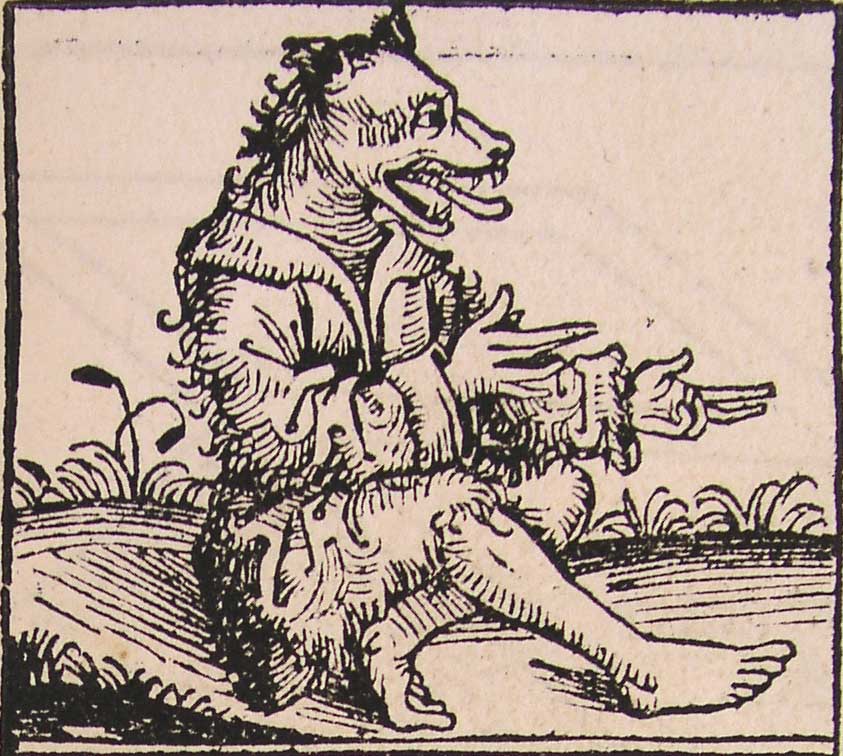
But the story itself was worth mentioning for entertaining purposes. The myth of strange folks living beyond the edges of the known world has endured and was attentively perpetuated. As such, dog-headed men appearing in Heodotus and other texts throughout antiquity, are still present in the Middle Ages. Partly out of respect for the established sources (auctoritates), partly out of a desire to amaze the readers, Marco Polo and Mandeville also tell of dog-headed people who ate their captured enemies. By the time Europeans were exploring the Americas and the remote corners of Asia, these creatures were very much a part of the collective imagination.

Dog-headed man, from the Nuremberg Chronicle, via Wikipedia

This made me think about knowledge which is taken as granted because it comes from an established source. It also made me think about people not being interested in finding out the truth because common knowledge or popular culture presents a different view of things. 

Some good years ago, I went to a party. Chatting with the people there, I was asked at some point where I was from. I said I was from Romania, and the man wanted to know where exactly in Romania. When I said Transylvania, he took offence, saying that "why do I take him for a fool, as everybody knew Transylvania was not a real place". I protested it was too, and he brought the argument that "it's a made-up place because you have Count Dracula who's from over there, and then there's a Queen of Transylvania putting on an appearance in My Fair Lady." In the end, I convinced him about my native lands being real, helped by another Romanian who was present.

I suppose the moral would be that one should not take things for granted, and that it's good for people to read a bit more and also take a little interest in current affairs and geography.

Readers can form an image of a place from books, as long as they discern what is common sense, what is pure propaganda, what is flight of fancy, and what is an exaggeration for literary purposes.

This brings me to a subject I am rather fond of: how Romania is seen in books. I haven't read yet Georgina Harding's Painter of Silence, set in pre- and post-World War 2 Romania. It's on my to-read list, I hope to return to this subject soon.

I did read, however, Patrick McGuinness' The Last Hundred Days, and I know it shows a very believeable and true Romania under the rule of Ceausescu. 

There are some representations of Bucharest which are not exactly geographically correct, but this aspect did not bother me a jot. I was too caught by the incredible air of reality of the  story, even in its most fanciful parts (such as an underground party / auction taking place in the Museum of History). This was because the characters - or rather the archetypes they represented - were true. So true that, with less than five minutes' thinking, I could point to real living (and dead) personages who made a seamless transition from Ceausescu's politruks to high priests of democracy and capitalism.

Thursday, 10 May 2012

Women, Guts, and Books. A Crime Reader's Delight

If there is a literary subject which has been treated again and again – and will continue to be so in the future – is that of women.

From Flaubert’s Madame Bovary to DH Lawrence’s Women in Love, and from Tolstoy’s Anna Karenina to Virginia Woolf’s A Room of One’s Own, women as main characters have occupied a prominent role in literature. We can go further back to Medea, Eloise, or Viola in The Twelfth Night, and many other strong (or less so but still fascinating) women characters.

Before I will be accused of misogynism, I will hurry to say that I am compelled to write this post because of a forthcoming book which features an exceptional woman, a character who, although crippled by mental instability, is the strongest character in the world she inhabits. Also, this book is written by a woman author.

I am talking here about Oana Stoica-Mujea’s Anatomical Clues (published originally in Romanian as Indicii anatomice in 2009). I hope Ramona Mitrica from Profusion Publishers will not mind me blabbing about the book prior to its UK publishing date.

Although there have been other women writers of crime fiction in Romania,
most notably the late Rodica Ojog-Brasoveanu, who introduced interesting women characters in her work, it seems to me Oana has created one of the strongest female leads in Romanian literature. Although her main character in Anatomical Clues, Detective Iolanda Stireanu, is fighting an army of internal demons, bereavement and childhood trauma, she is still the strongest person in the book. Self exiled in her “ivory tower” on the top-most floor of a Bucharest block of flats, Iolanda fights crime aided by her razor-sharp intellect, by high end technology and a not-too-willing proxy, a woman journalist who acts on the ground as her eyes and ears.

I won’t go on too much about the plot as I don’t want to ruin your reading experience. Suffice to say that Oana Stoica-Mujea’s style of writing is gripping, gutsy, and full of unexpected twists. I know the expression sounds trite, but this story really is a page-turner that will keep you hooked.

Anatomical Clues is part of the Profusion Crime Series initiated by ProfusionPublishers, a new independent British publisher that brings the finest Eastern European crime writing on the English-speaking book market. 


- - - -
edit July 2012

Anatomical Clues is now available in paperback from ProfusionPublishers, Amazon.co.uk, and can be ordered from Waterstones.com. It is also available as a Kindle e-book

 You can read a free sample on Profusion’s website by clicking here

Friday, 4 May 2012

Piano Pianissimo from Russia to Romania and Sweden

A little while ago, I went to a concert at the Royal Festival Hall. And before you ask - yes, this is still about books.

The programme was: Sibelius' Night Ride and Sunrise, Rachmaninov's Piano Concerto no 2, and Tchaikovsky's Symphony no 6. I am not a classical music buff, but I do love Rachmaninov, and the 2nd is probably my all time favourite piece of classical music ever. And as I have nothing against Sibelius and Tchaikovsky either, I had enough reasons to book a seat in good time.

When the conductor - a grand man called Leif Segerstam - came on stage, I was struck by the fact that he looks very much like a cross between Karl Marx and a biblical patriarch. He is an impressive presence, and although he was moving a little stiffly, he had a very animated and (I suppose) persuasive style of conducting, at times taking the whole orchestra under his impressive wingspan.

The piano piece was performed by Denis Matsuev, a musician I can only describe as a genius and virtuoso. Suffice to say that at the end of the concerto, people clapped so loudly and for such a long time that I remembered the olden days when The Comrade was holding plenary meetings and speechifying. When the texts were published, they were scattered with parantheses such as "Prolonged applause and ovations. The audience is chanting slogans Ceausescu and the People".

Matsuev got three curtain calls and many boucquets, and at the third call he sat at the piano and played his own version of Figaro's aria, unleashing further applauses.

This concert made me think about books with pianists in an important role. Or at least books in which people who play the piano impressed me for a reason.

I thought long and hard and found only three books in my reading list, excluding from the start the piano playing that is de rigueur in the majority of 19th century novels.

The first one that came to my mind is a Romanian classic, La Medeleni by Ionel Teodoreanu, a roman flueve charting the lives and complicated love lives of the Deleanu family's children. The Deleanus were small nobility from Moldavia, and the opening salvo takes place on their estate, Medeleni, in a semi-bucolic arrangement. I don't remember Madame Deleanu playing the piano, but I remember she was doing pianotage, playing an inexistent keyboard when she was in a bad mood.

This led to another book which is not about a pianist, the Saga of Gosta Berling by Selma  Lagerlof, better known (not in the UK, unfortunately) for the fantastic children book The Wonderful Adventures of Nils Holgersson. The Saga of Gosta Berling features, besides the eponymous hero who is a defrocked priest, a strange array of "cavaliers", one of them being a great admirer of Beethoven. His name is Lovenborg and he holds Ludwig in such esteem that he dares not play his works on a piano, but only a wooden table with a painted keyboard. And when he plays it "He hears every note with unearthly clearness. He sits there glowing with enthusiasm and emotion, hearing the most wonderful tones".

The third book is Elfriede Jelinek's Piano Teacher. But it counts only as half a book here, as I only saw the film and read two or three chapters.The Guardian described it as a "demented love story [in which] the hunter is the hunted, pain is pleasure, and spite and self-contempt seep from every pore." 

Suggestions of books with pianists welcome.